
It’s a wild ride out in Davos this year, as it tries to stop its theme “A spirit of dialogue” becoming a meme.
Before we deep dive into Davos 2026, here are our takeaways till now
1. The Trump Rollercoaster: Donald Trump’s long speech focussed on Greenland threats, tariff talk, maximum disruption. By the evening he’d backed off, after making a deal with NATO Secretary General Mark Rutte (at the time of publication, still to be accepted by Greenland and Denmark).
2. Global Order Fractures: Emmanuel Macron in all his shaded glory and Mark Carney warned the rules of international order are breaking. Carney’s speech is being heralded as one that other world leaders need to pay attention to.
3. ‘Board of Peace’: The big promise on Gaza and Ukraine was announced, though it is currently thin on detail. The UK among others has not signed on (yet) saying its dangerously close to mirroring the UN charter. Other nations have signed up (unclear if fees have already been paid).
4. AI = Job Shock: Palantir CEO Alex Karp has predicted mass job losses and has also stated AI’s purpose will be to end large scale immigration.
5. Greenlash vs Reality: Climate and Davos? Seemingly now a check-box exercise. Climate hesitation has come head to head with the $5tn green economy.
Pièce de Résistance: The Lagarde Walk-Out
The one that caught everyone’s attention (especially ours) though, was Blackrock CEO Larry Fink’s VIP dinner at Davos (Larry is also a co-chairman of the WEF). It spiralled into chaos after a speech by US Commerce Secretary Howard Lutnick, as first reported by the Financial Times.
European Central Bank President Christine Lagarde led a walkout over Lutnick’s jabs at Europe’s “uncompetitive” economies, prompting others to follow her out of the room.
Al Gore openly heckled Lutnik at that same dinner over remarks favouring coal over renewables. With jeering spreading and guests exiting, Fink was forced to end the dinner early. Dessert was cancelled. The meltdown capped Lutnick’s insistence that Trump’s was the “new sheriff in town”.
The Davos establishment was clearly unimpressed.
Thanks for reading! Please share widely and support changing the narrative about women leading the world.
Davos Is Talking Equality. The Badges Still Tell Another Story
By Jessica Jurkschat
Davos is underway, and gender equality is once again a central theme at the World Economic Forum’s Annual Meeting 2026. Running alongside the Forum this week, the World Woman Davos Agenda is advancing its #EqualityMoonshot. A multi-stakeholder initiative positioning women’s leadership as critical to the next phase of global growth. The Moonshot focuses on accelerating women’s participation and influence across AI, finance, innovation, education, health, and sustainable economic systems, with an explicit emphasis on moving from commitments to capital, and from visibility to decision-making power.
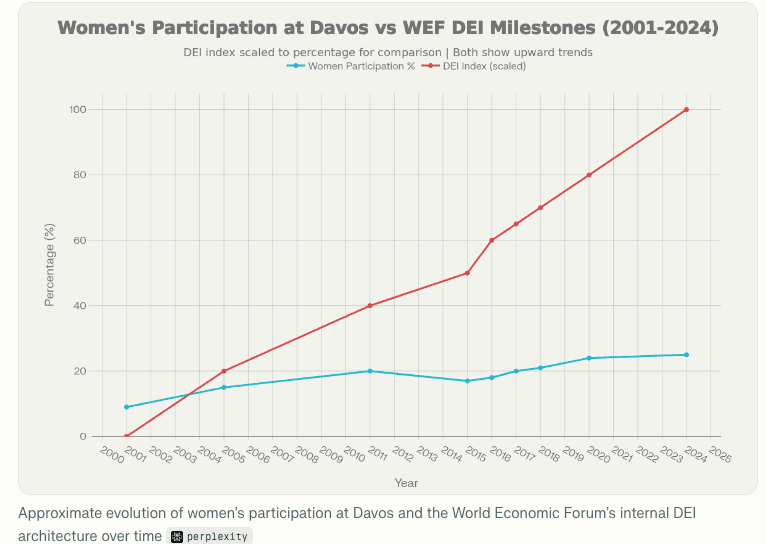
The framing is pragmatic, reflecting the reality of 2026. The data, however, shows that for all the talk, the movement toward equality still lags the rhetoric. Men still account for roughly three-quarters of participants, a ratio that has only improved gradually since the early 2000s, when women represented well under 10%. Women now account for roughly one-fifth to just over one-fifth of Davos attendees in recent years, the highest proportion on record since the mountaintop gathering began, but the figure has largely stagnated at this level despite sustained focus on diversity and inclusion.
While the Forum does not publish a detailed gender breakdown of Davos participants, independent analyses over the years have pieced together a consistent picture: access for the approximately 3,000 attendees follows the same patterns as global leadership more broadly. There is a clear hierarchy of badges, each signalling a participant’s role and status and shaping where they can go and who they meet. The coveted white badge, which provides broad access to the Congress Centre and many closed-door sessions, senior convening, and high-level negotiations, remains concentrated among CEOs, heads of state, ministers, and institutional leaders. These are roles that remain disproportionately male across business, politics, and finance, and that reality is visible on the ground in Davos.
Below that sit the other colours: badges for senior government officials, staff, media, security, and partners, each conferring more limited access to spaces and conversations. All come at a cost, whether through institutional membership fees, participation charges, or the practical costs of hotels and travel. And even holding an official badge does not guarantee a seat in any given session; the real gatekeeping still operates through individual event guest lists, private invitations, and security protocols.
This imbalance sits alongside an increasingly formalised DEI framework. Since the introduction of delegation guidelines in 2011, the World Economic Forum has expanded gender-gap reporting, parity benchmarks, and flagship initiatives, including the Gender Parity Sprint and DEI Lighthouse Programme. Critics argue that much of the increase from around 10% women attendees to the often-touted 25% has been driven by programmes such as the Young Global Leaders community, rather than a structural transformation of core leadership delegations — and that recent gatherings have been marked by a visible backlash against perceived tokenism and quota-driven selections.
In 2026, the focus at Davos has sharpened further toward women’s leadership in AI, financial systems, and emerging technologies. Sectors where economic power and strategic influence are consolidating at speed, and where representation is already a contested fault line.
As Davos unfolds and a shifting world order is debated at length, the question is no longer whether gender equality makes it onto the agenda, but who is actually at the table to shape the decisions. The programme suggests urgency, as it should. The composition of the room, despite the rhetoric, still suggests continuity more than change.
A Request to our subscribers:
Please SHARE & COMMENT if what we cover resonates with you! These are the only ways to keep The Chief Brief free and possible, by expanding our reach!
Help us beat the algorithm! Spread the word! Women are more than a check box in the world’s affairs!
Experts in geopolitics, economics, technology, and society delivering sharp, concise analysis on the forces shaping our world.
More from The Chief Brief
View All → Conflict Watch
May 7th Broke Two Governments. Only One PM Got the Memo
Latvia’s PM Evika Siliņa resigns, In Britain, Keir Starmer is still in Downing Street. Just about.
 Climate & Environment
Fossil Fuel Exit Club
57 countries met in Colombia to agree on how to phase out oil, gas, and coal. The US, China, Russia, India, and Saudi Arabia were not among them.
 The Macro
IMF Spring Meetings 2026: The $20 Trillion Report Nobody Talked About
The most expensive oversight of the week
 Editor's Take
Europe Is Being Rewritten. Here’s What That Actually Looks Like
From Budapest to Rome to Beijing: How Europe’s Political Certainties Collapsed in One Week

Get the Brief
Sharp analysis and global perspectives delivered to your inbox.
By subscribing, you agree to our Privacy Policy
Subscribe to The Chief Brief
Essential insights on geopolitics, business, AI, and society — delivered daily.
Subscribe to The Chief Brief
Essential insights on geopolitics, business, AI, and society — delivered daily.