From Moscow with Mischief: Reality Bites
Hot Summer, Hotter Headlines & What to do about a problem like Putin?

The Chief Brief team is back from some much-needed R&R, only to land straight into a city-wide strike on London’s Underground, our daily lifeline. A reality check, really. Like much of the world, we’re being jolted awake just after a summer where, for a fleeting moment, we drowned our worries in Rosé and pretended the relentless climate change-fuelled sunshine was a gift rather than a warning.
This week, we are delighted to feature who breaks down the US, EU, Russia & NATO drama and what it all means for the global order.
If you’ve been blissfully hiding from the news this summer, we salute you. Sadly, the world didn’t stop while you topped up your tan. Here’s the cheat sheet to get you back up to speed.
- The U.K.’s Deputy PM Angela Rayner has bowed out after a row over Stamp Duty on her home. Now the British Labour party is scrambling for a new Deputy Leader, with fresh rumours of another stitch-up already swirling. Read more at BBC
- 33 Tech CEOs gathered for a White House dinner that drew quite a bit of attention for the fawning nature of the CEOs comments to U.S. President Donald Trump. AMD CEO Lisa Su was one of many to praise President Trump for his support of the tech industry. Read more at The Wired
- Martha Lane Fox has warned, Misogyny is spreading in the tech industry. The Lastminute founder says a CEO told her tech was ‘done with women.’ Read more at The FT
- Thailand’s PM Paetongtarn Shinawatra resigned and now faces five tough investigations, one potentially banning her from politics for life. Meanwhile, her father, former PM Thaksin Shinawatra, has been ordered back to jail. The Shinawatra dynasty is in legal crossfire as Thailand teeters on political uncertainty. Read more at The Nation
- Former German Foreign Minister Annalena Baerbock has became the 80th president of the United Nations General Assembly, and the fifth woman to hold the position. Read more at Forbes
The Russia Problem
Donald Trump, Volodymyr Zelenskyy and Europe’s leaders met in August, with the official write-up reading like a diplomatic rom-com. The reality? President Trump swerved EU Commission President Ursula von der Leyen’s Ukraine pitch to bang on about EU trade deals. Hard to tell if Europe was even at the same table, given the so-called ‘Coalition of the Willing’ is still peddling more fiction than fact.
Meanwhile this week, Russian drones have breached Polish airspace 19 times. Has that nudged NATO or the White House to shift tack? It is too early to say. What we do know: Polish President Donald Tusk called it the first time a significant swarm entered from Belarus and warned,
“This situation brings us the closest we have been to open conflict since World War Two.”
It’s a reminder that the shifting sands around NATO began with that headline-grabbing Trump–Putin meeting in Alaska.
This week, we’re delighted to bring you the perspective of , Senior Geopolitical Risks Advisor at ODI. Her expertise spans the geopolitics of critical minerals, energy security, and the cascading impacts of climate and geopolitical risks on global supply chains. She also leads portfolios on Ukraine’s reconstruction and the Russia-Ukraine war, analysing their evolving implications for the global order.
While originally published almost 4 weeks ago, Olena’s incisive take is still very much valid, as Russia continues to pound Ukraine with missiles and drones.
You can find Olena’s original published article at The Conversation
Alaska summit: no deal agreed at Trump-Putin meeting but land swap for ceasefire still on the table
by Olena Borodyna
Hours before meeting Russia’s leader Vladimir Putin in Alaska, Donald Trump said he wanted to see a ceasefire in Ukraine and was “not going to be happy” if it wasn’t agreed today. The US president appears to have left Alaska with no such agreement in place.
“We didn’t get there”, Trump told reporters, before later vaguely asserting that he and Putin had “made great progress”. Trump is likely to return to the idea of engaging Putin in the coming weeks and months, with the Russian leader jokingly suggesting their next meeting could be held in Moscow.
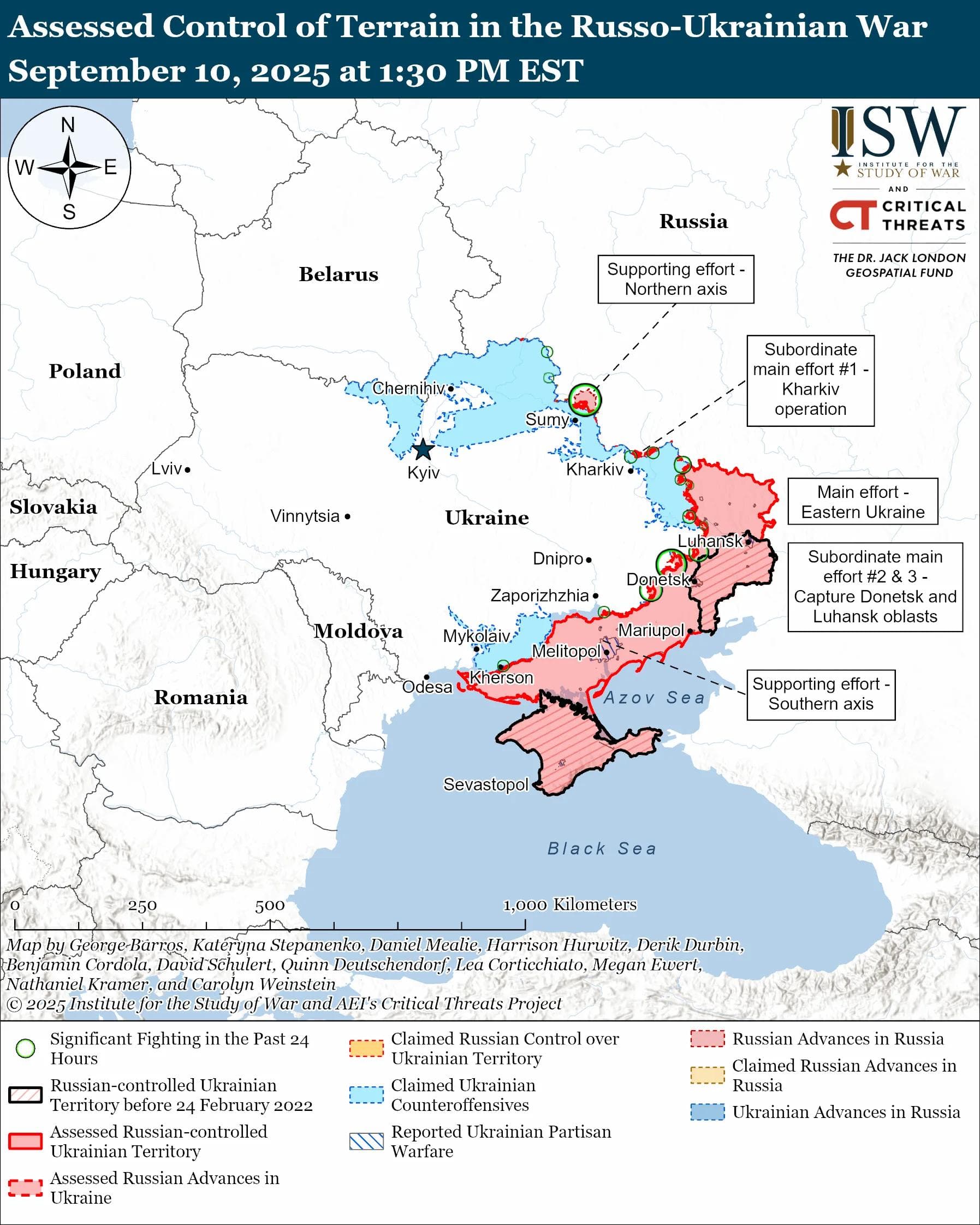
A land-for-ceasefire arrangement, an idea Trump has repeatedly raised as an almost inevitable part of a peace settlement between Russia and Ukraine, could still reemerge as a possible outcome. In fact, in an interview with Fox News after the summit where Trump was asked how the war in Ukraine might end and if there will be a land swap, Trump said: “those are points that we largely agreed on”.
Securing territorial concessions from Ukraine has long been one of Moscow’s preconditions for any negotiations on a peace deal. Putin is likely betting that insisting on these concessions, while keeping Ukraine under sustained military pressure, plays to his advantage.
Public fatigue over the war is growing in Ukraine, and Putin will be hoping that a weary population may eventually see such a deal as acceptable and even attractive. Russia launched a barrage of fresh attacks against Ukrainian cities overnight, involving more than 300 drones and 30 missiles.
Ukrainian president Volodymyr Zelensky, who was excluded from the Alaska summit, has maintained that Kyiv will not agree to territorial concessions. Such a move would be illegal under Ukraine’s constitution, which requires a nationwide referendum to approve changes to the country’s territorial borders.
The assumption behind a land-for-ceasefire deal is that it would enhance Ukrainian and European security. Trump sees it as the first step in bringing Putin to the negotiation table for a broader peace deal, as well as unlocking opportunities for reconstruction. In reality, such a deal would do little to diminish the longer-term Russian threat.
Moscow’s efforts to shore up and modernise its defence capabilities and neo-imperial ambitions would remain intact. Its hybrid attacks on Europe would also continue, and Ukraine’s capacity to secure meaningful reconstruction would be weakened.
Whether or not Russia ever opts for a direct military strike on a European Nato member state, it has no need to do so to weaken the continent. Its hybrid operations, which extend well beyond the battlefield, are more than sufficient to erode European resilience over time.
Russia’s disinformation campaigns and sabotage of infrastructure, including railways in Poland and Germany and undersea cables in the Gulf of Finland and Baltic Sea, are well documented. Its strategic objectives have focused on deterring action on Ukraine and sowing disagreement between its allies, as well as attempting to undermine democratic values in the west.
Europe is under pressure on multiple fronts: meeting new defence spending targets of 5% of GDP while economic growth is slowing, reducing the dependence of its supply chains on China and managing demographic challenges.
These vulnerabilities make it susceptible to disinformation and have deepened divisions along political and socioeconomic fault lines – all of which Moscow has repeatedly exploited. A land-for-ceasefire deal would not address these threats.
For Ukraine, the danger of such a deal is clear. Russia might pause large-scale physical warfare in Ukraine under a deal, but it would almost certainly continue destabilising the country from within.
Having never been punished for violating past agreements to respect Ukraine’s territorial integrity, such as when it annexed Crimea in 2014, Moscow would have little incentive to honour new ones. The government in Kyiv, and Ukrainian society more broadly, would see any accompanying security guarantees as fragile at best and temporary at worst.
The result would probably be a deepening of Ukraine’s vulnerabilities. Some Ukrainians might support doubling down on militarisation and investment in defence technologies. Others, losing faith in national security and reconstruction, could disengage or leave the country. Either way, in the absence of national unity, reconstruction would become far more difficult.
Making reconstruction harder
Ukraine’s reconstruction will be costly, to the tune of US$524 billion (£387 billion) according to the World Bank. It will also require managing a web of interconnected security, financial, social and political risks.
These include displacement and economic challenges brought on by the war, as well as the need to secure capital flows across different regions. It will also need to continue addressing governance and corruption challenges.
A permanent territorial concession would make addressing these risks even more difficult. Such a deal is likely to split public opinion in Ukraine, with those heavily involved in the war effort asking: “What exactly have we been fighting for?”
Recriminations would almost certainly follow during the next presidential and parliamentary elections, deepening divisions and undermining Ukraine’s ability to pursue the systemic approach needed for reconstruction.
Ongoing security concerns in border regions, particularly near Russia, would be likely to prompt further population flight. And how many of the over 5 million Ukrainians currently living abroad would return to help reconstruct the country under these conditions is far from certain.
Financing reconstruction would also be more challenging. Public funds from donors and international institutions have helped sustain emergency energy and transport infrastructure repairs in the short term and will continue to play a role. But private investment will be critical moving forward.
Investors will be looking not only at Ukraine’s geopolitical risk profile, but also its political stability and social cohesion. Few investors would be willing to commit capital in a country that cannot guarantee a stable security and political environment. Taken together, these factors would make large-scale reconstruction in Ukraine nearly impossible.
Beyond fundamental issues of accountability and just peace, a land-for-ceasefire deal would be simply a bad bargain. It will almost certainly sow deeper, more intractable problems for Ukraine, Europe and the west.
It would undermine security, stall reconstruction and hand Moscow both time and a strategic advantage to come back stronger against a Ukraine that may be ill-prepared to respond. Trump would do well to avoid committing Ukraine to such an arrangement in further talks with Putin over the coming months.
Please share widely, like and comment to help us beat the algorithm! Spread the word! Women are more than a check box in world affairs!
Experts in geopolitics, economics, technology, and society delivering sharp, concise analysis on the forces shaping our world.
More from The Chief Brief
View All → Conflict Watch
May 7th Broke Two Governments. Only One PM Got the Memo
Latvia’s PM Evika Siliņa resigns, In Britain, Keir Starmer is still in Downing Street. Just about.
 Climate & Environment
Fossil Fuel Exit Club
57 countries met in Colombia to agree on how to phase out oil, gas, and coal. The US, China, Russia, India, and Saudi Arabia were not among them.
 The Macro
IMF Spring Meetings 2026: The $20 Trillion Report Nobody Talked About
The most expensive oversight of the week
 Editor's Take
Europe Is Being Rewritten. Here’s What That Actually Looks Like
From Budapest to Rome to Beijing: How Europe’s Political Certainties Collapsed in One Week

Get the Brief
Sharp analysis and global perspectives delivered to your inbox.
By subscribing, you agree to our Privacy Policy
Subscribe to The Chief Brief
Essential insights on geopolitics, business, AI, and society — delivered daily.
Subscribe to The Chief Brief
Essential insights on geopolitics, business, AI, and society — delivered daily.