This Week's Brief
AI Slop, Going Male, Budget Bonfire, Jail Time, Tanzanian Sanctions, Pay Gap Gains/Losses, Launching the Weekly Conflict Watch

Letter from our editor,
This week has kicked off with a real sign of the times.
Macquarie Dictionary has officially crowned “AI slop” as Word of the Year.
Yes! Humanity looked at everything happening in the world and said:
“The real cultural moment? The garbage content our algorithms keep feeding us.”
It even beat “Ozempic face.” Which frankly deserved at least an honourable mention for effort.
But here’s the part I loved: AI slop won because it “reflects a major societal shift.” Of course it does. We’re all swimming in low-effort machine mush, with our politicians pushing more and more investments into it, without any new data for the LLMs to learn from and the same slop feeding and amplifying biases of all sorts. All while we pretend everything is fine.
So as ‘AI slop’ conquers the dictionary, The Chief Brief returns this week with what we do best: No slop. No sludge. And definitely no synthetic wisdom.
Just clarity, context, and women who actually know what they’re talking about - the good, bad and the ugly!
Shall we begin? It’s a long list this week..gear up!
These pins mark the stories with deeply buried, but globally significant signals.
📌 UK Reeves’s Budget Bonfire
📌 Bangladesh’s Power Bloc Unravels Across Continents
📌 Ukraine Reconstruction Gets an Old Hand
📌 Gender Hack Unveils Algorithm Bias on LinkedIn
📌 Swiss Voters Say No to Women’s Military Service and Inheritance Tax
📌 Emirati Women Work The Longest
📌 Women’s Cricket Goes Big in Saudi
📌 Labour Overhaul Sparks Protests In India
📌 Gender Pay Gap Still a Wedge Down Under
📌 Kenya’s Extreme Wealth, Extreme Inequality
📌 South Korean Securities Firms Still Pay Men More
📌 Introducing Our Weekly: Conflict Watch
Politics This Week
🇬🇧 UK Reeves’s Budget Bonfire
Britain’s first female chancellor made history this week and it’s not the kind that will be remembered fondly in the years to come. Rachel Reeves’s Autumn 2025 budget has pushed the UK’s tax burden toward a record 38% of GDP by the end of the parliament, thanks to frozen income tax thresholds, fresh property (“mansion”) tax, dividend taxes and other delayed-action levies whose real bite will land after 2028, just ahead of the next general election.
The Office of Budget Responsibility (OBR) responsible for analysing the budget’s impact calls it, “spend now, pay later.” It has warned of slower growth, higher debt servicing costs, and inflation that will drag the labour force into higher tax bands through stealth. The OBR’s chief had to resign after its analysis was released/leaked on its website, an hour before the Chancellor’s statement. Read more at Sky News
Reeves has since countered critics claiming she’s filling the crater left by her Conservative party predecessors, while promising “no return to austerity.”
The UK Budget, In Short:
Big tax hikes for high earners to fill a £22bn black hole.
- Tax threshold freeze, but no hikes to income tax rates or VAT.
- Reduction in pension (salary sacrifice) threshold and ISA (savings) threshold
- Mansion tax on properties over £2 million
- Two-child benefit cap lifted, funded by anti-fraud and higher gambling tax.
- Libraries, playgrounds, NHS staff, GPs, and devolved governments all get more funds.
- Rail fares and prescription charges frozen; customs duties tweaked for online shopping.
- Capital gains tweaks for businesses
- Inheritance tax adjustments.
🇧🇩 Bangladesh’s Power Bloc Unravels Across Continents
Bangladesh’s political drama has edged into a full Shakespearean tragedy. Former prime minister Sheikh Hasina, now based in India, has been hit with a new 21-year sentence in three corruption cases over illegal land allocations. This follows a death sentence handed down just days earlier, for alleged crimes linked to a 2024 crackdown on student protesters that ended her rule.
A Dhaka court ruled Hasinaused her office to secure prime plots in a property project for herself and her family “despite ineligibility,” calling it evidence of “unchecked power” and a “greedy eye for public property.” Her children, Sajeeb Wazed and Saima Wazed (whose WHO appointment was called a moment of undue influence and corruption) have also got five year sentences in one case.
The fallout has now reached the UK: Labour MP Tulip Siddiq, tried in absentia, has been sentenced to two years in jail on alleged corruption charges. The court claims she leveraging her aunt Hasina’s influence to secure land in Bangladesh for family members. Siddiq’s mother was sentenced to seven years.
The UK MP has denied the charges, claiming that much of the evidence being presented by prosecutors was forged. The UK Labour party says it does not recognise the corruption judgment against Siddiq because she was denied the opportunity to a fair legal process in the case. With no extradition treaty between the UK and Bangladesh, it is unlikely for any sentence to be served. Read more at The Spectator
🇺🇦 Ukraine Reconstruction Gets an Old Hand, Not a New Face
As Kyiv navigates political turbulence, President Zelensky has tapped a familiar force: Oksana Markarova, Ukraine’s former ambassador in Washington and ex–finance minister. She is now an unpaid presidential advisor on reconstruction and investment.
Her brief: sharpen the business climate, strengthen financial resilience, attract capital, and plan Ukraine’s reconstruction with strategic partners. The timing of her appointment matters. Zelensky’s powerful chief of staff, Andriy Yermak, resigned on Nov. 28 amid a corruption probe. Rumours that Markarova was offered the job and refused? She says absolutely not. Read more at The Kyiv Independent
🇹🇿 Tanzania | The Rule of Law Heads for the Exit
Tanzania is edging closer to breaking up with the International Criminal Court. Calls for an ICC probe, backed by international legal experts into alleged mass killings, kidnappings, and attacks on opposition figures during post-election protests have triggered a political backlash in Tanzania’s capital Dodoma.
President Samia Suluhu Hassan has launched a national commission to “investigate” the violence, calling it “shocking” for a country long considered East Africa’s stable anchor. She claims young protesters were paid to take to the streets and wants to know “where this money came from.”
In the meantimeThe European Parliament passed a scorching resolution (539 votes in favour, none against) condemning Tanzania’s deteriorating human rights record after the disputed 2025 elections.
Brussels wants an African-led independent inquiry, accountability for abuses, alleged ballot tampering, opposition exclusions, enforced disappearances, arbitrary detentions, killings, and a sweeping crackdown on dissent. The Bloc’s Parliament has also raised the spectre of EU sanctions and is calling for a halt to direct financial support for Tanzanian authorities, arguing that continued engagement without accountability undermines Europe’s own human rights commitments. Read more at Business Insider
Society This Week
Gender Hack Unveils Algorithm Bias on LinkedIn
Women on LinkedIn are swapping their profiles to “male” and seeing their engagement soar. LinkedIn users have claimed the platform suppresses women. It is yet unclear if the gender switch has benefited women of colour. LinkedIn in the meantime has pushed back claiming the algorithm doesn’t factor in gender; it prioritises hundreds of signals, including network, industry, and activity. Skeptics remain unconvinced as a petition for transparency gains traction. Read more at The Independent
Japanese Succession, The Conservative Guard Doesn’t Want Women
Aiko, Princess Toshi is the only child of Emperor Naruhito and Empress Masako and is Japan’s wildly popular pop-star princess. She turned 24 this week, amid calls for a change to the country’s male-only succession to the throne law. But conservative lawmakers, including Japan’s first female Prime Minister Sanae Takaichi, oppose change. With the younger generation of royals nearly extinct, experts warn the male-only succession law risks ending the monarchy altogether. Read more at ABC News
Swiss Voters Say No to Women’s Military Service and Inheritance Tax
Swiss voters voted to reject two critical proposals this week: extending compulsory civic/military service to women (84% rejected) and a 50% inheritance tax on fortunes over CHF 50m and direct the funds toward measures to mitigate climate change (79% rejected). Voter Turnout was 43% and both initiatives failed to garner wider political support from the Swiss government or other parties, having been predicted to be defeated. Read more at AP
Labour Overhaul Sparks Protests In India
Indian Prime Minister Narendra Modi’s labour law revamp, pegged as the country’s biggest since independence is triggering street-level and union blowback. Four new codes are set to compress 29 old laws, formalise gig work, extend social security, set minimum wages, and lift restrictions on women’s employment. But easing hiring and firing for big companies has unions claiming that in reality it means “labour rights demolished,” while SME’s are concerned about the cost of implementation. Read more at the FT
UAE’s Women Run The Region
Emirati women now clock the region’s longest weekly work hours for women: at 48.5 hours. This means they work slightly longer hours on average than Emirati men (48.3 hours) and women in other countries in the region, such as Qatar (47.6 hours), Oman (39.2 hours) and Saudi Arabia (37.1 hours). The country also tops the Arab world for gender balance in the 2025 Global Gender Gap Report and ranks 13th in the UNDP Gender Equality Index. Currently, women hold 26% of Cabinet positions in the UAE, 63% of government leadership roles and make up 71% of all skilled Emirati nationals within the private sector. Read more at Gulf News
Women’s Cricket Goes Big in Saudi
Saudi Arabia is launching a Women’s T20 tournament next year, featuring stars from England, Australia, and India. The five year partnership will comprise a six-team event, sanctioned by the ICC and run by FairBreak Global, will take place between the 2026 edition of The Hundred and Australia’s WBBL. Read more at ESPN CricInfo
Business This Week
Gender Pay Gap Still a Wedge Down Under
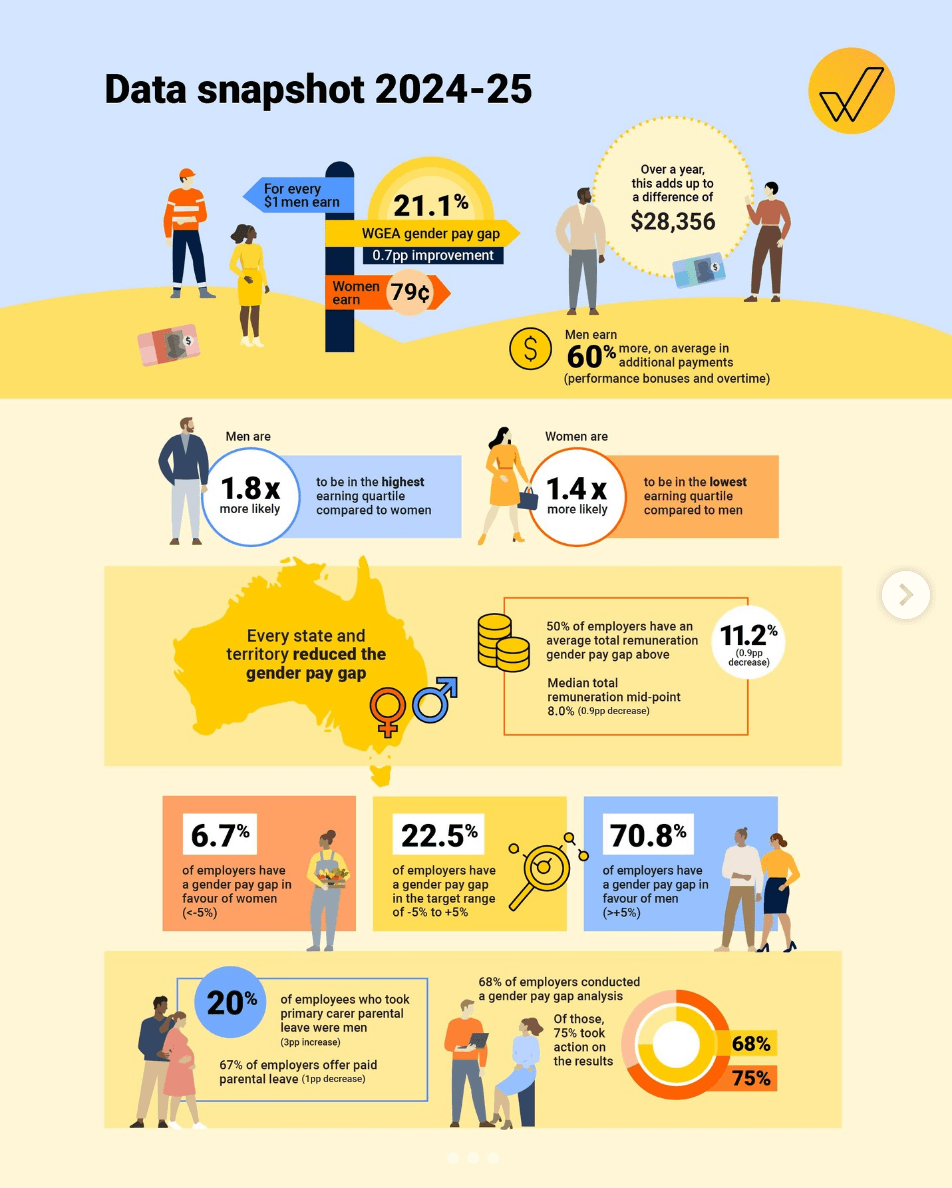
Private sector gender pay gap in Australia has shrunk 0.7% to 21.1% this year, from 21.8% last year. This means women earn 78.9 cents to every dollar earned by a male, a gap of AUD 28,356 per year. WGEA CEO Mary Wooldridge said the 0.7% “reduction is larger than the trend of the previous 5 years”.
The WGEA’s data on CEO salaries shows that the gender pay gap between women and men CEOs increased by 1.2% to 26.2% in the past 12 months, an average difference of $83,493 in base salary every year.
Australia’s public sector has performed better with the wage gap at 6.4%. And interestingly, in the 2024-25 period, men accounted for 20% of parental leave taken, a 3% rise from the year prior. Read more at WGEA
Kenya’s Extreme Wealth, Extreme Inequality
125 individuals now hold more wealth than 77% of Kenya’s total population of 42.6 million people. In sharp contrast to the 125 ultra wealthy Kenyans, Oxfam Kenya reports nearly half of the population live in extreme poverty, with the number having increased by 7 million (37%) since 2015. CEOs in the country now earn 214 times more than secondary school teachers. Women fare worst: earning KSh 65 per KSh 100 men earn. They are also five times more likely to do unpaid care work, and currently hold only 13% of agricultural land rights (dropping to 4% in poorest households). Read more at Oxfam Africa
South Korean Securities Firms Still Pay Men More
Women in top 10 securities firms (making up 43.6% of all employees) earned an average of 66% of male salaries, though the gap has narrowed over five years (from 58.8%) according to reports disclosed by South Korea’s Financial Supervisory Service. Firms like Meritz Securities showed the widest gap, where women earned 51.5% of men’s pay despite longer average tenures. Meritz was followed by Korea Investment & Securities and Daishin Securities in the biggest gap. Overall, the gap has shrunk by 7.6% with women’s pay rising 30.2% versus men’s 15.3%, showing slow, uneven progress. Read more at Korea Times
Thanks for reading! This post is public so feel free to share it.
⛈️ Natural Disaster Watch
Floods Kill Over 1,100 in Asia
Devastating floods across Sri Lanka, Indonesia, Thailand, and Malaysia have claimed over one thousand lives, so far.
• Sri Lanka: Cyclone Ditwah has triggered floods and landslides; 390 dead, 228 missing, 1.1 million people impacted. International aid has been requested by the government.
• Indonesia: 604 dead and counting, 460+ missing. Aceh, North Sumatra, and West Sumatra hardest hit; hundreds of thousands evacuated.
• Thailand: 176 dead; 2.6 million people are affected. Southern Thailand hardest hit due to submerged communities.
• Malaysia: 2 dead, 34,000 people evacuated.
Military and emergency services are scrambling across affected provinces, as the region braces for ongoing recovery.
🌍 Conflict Watch
676 million women, that is nearly 17% of the global female population lived within 50 km of a deadly conflict in 2024-2025. That’s the highest since the Cold War.
At The Chief Brief, we’re committed to keeping you updated weekly on the conflicts often forgotten, and keep a spotlight on the women trapped on the frontlines of today’s wars.
Here are this week’s updates:
Russia–Ukraine War
Russia has made its biggest advance in a year, pushing towards Pokrovsk, a strategic transit hub whose fall would choke Ukrainian supply lines. There have been reports pointing to a new U.S. peace-plan framework, chatter around possible NATO “pre-emptive strikes”, and suggestions of another U.S.-brokered deal on the table.
Israel–Gaza Armed Conflict
Gaza’s Hamas-run health ministry reports 70,100 people have been killed since Israel’s offensive began in 2023, with 350+ deaths recorded after the U.S.-brokered 10 October 2025 ceasefire. Pope Leo XIV has reiterated the Holy See’s long-held view: a two-state solution remains “the only solution”.
Israel–Lebanon War
Despite the U.S.-brokered November 2024 ceasefire, Israel’s strikes on alleged Hezbollah targets continue. The latest hit an apartment block in Beirut, killing at least five and wounding 28. Lebanon’s health ministry says more than 270 people have been killed and around 850 wounded by Israeli actions since the ceasefire.
Israel–Syria War
Tensions are rising after hundreds of Israeli strikes in Syria. The deadliest yet reportedly killed 13 people last week, with Israel claiming it targeted an Islamist group. U.S. President Donald Trump warned Israel on social media against destabilising Syria’s new leadership, hours before calling Prime Minister Netanyahu.
Sudan Civil War
A ‘FRANCE 24 Observers’ investigation reports the first proof of the use of chemical weapons in the civil war. The investigation reveals chlorine gas was used by Sudan’s army to retake a refinery from the RSF, with barrels dropped near Khartoum on 5 and 13 September 2024. Read more at France 24
In the meantime, Washington’s senior Africa envoy, Massad Boulos, has rejected claims that the latest U.S.-backed ceasefire plan is biased. Sudan’s army says any peace proposal involving the UAE will remain unacceptable, accusing Abu Dhabi of supporting the RSF, an allegation the UAE denies.
DRC–Rwanda Backed Conflict
President Donald Trump is set to host DRC President Félix Tshisekedi and Rwanda’s Paul Kagame for what the White House is billing as a “historic peace and economic agreement”. The conflict, driven by alleged Rwandan support for M23 rebels, continues to devastate eastern DRC.
Congolese Nobel Peace Laureate Dr Denis Mukwege has condemned the Washington–Doha initiative as “illegitimate” and incapable of bringing lasting peace, accusing foreign players of “predatory” designs on the region’s mineral wealth.
Haiti Civil Unrest
Heavily armed gangs rampaged through Haiti’s central region over the weekend, killing civilians, torching homes and forcing families to flee overnight. Police say 50% of the Artibonite region of Haiti is now under gang control. 1.4 million people are now displaced and more than half the population facing crisis-level hunger.
Pakistan–Afghanistan Border (Durand Line)
Saudi Arabia quietly convened direct talks between Pakistan and Afghanistan (per sources) to ease soaring tensions over cross-border militancy. The Riyadh meeting has seemingly ended without progress, with both sides sticking firmly to long-held positions and no public acknowledgement the talks even happened.
A Request to our subscribers:
Help us beat the algorithm! Spread the word! Women are more than a check box in world affairs!
Experts in geopolitics, economics, technology, and society delivering sharp, concise analysis on the forces shaping our world.
More from The Chief Brief
View All → Conflict Watch
May 7th Broke Two Governments. Only One PM Got the Memo
Latvia’s PM Evika Siliņa resigns, In Britain, Keir Starmer is still in Downing Street. Just about.
 Climate & Environment
Fossil Fuel Exit Club
57 countries met in Colombia to agree on how to phase out oil, gas, and coal. The US, China, Russia, India, and Saudi Arabia were not among them.
 The Macro
IMF Spring Meetings 2026: The $20 Trillion Report Nobody Talked About
The most expensive oversight of the week
 Editor's Take
Europe Is Being Rewritten. Here’s What That Actually Looks Like
From Budapest to Rome to Beijing: How Europe’s Political Certainties Collapsed in One Week

Get the Brief
Sharp analysis and global perspectives delivered to your inbox.
By subscribing, you agree to our Privacy Policy
Subscribe to The Chief Brief
Essential insights on geopolitics, business, AI, and society — delivered daily.
Subscribe to The Chief Brief
Essential insights on geopolitics, business, AI, and society — delivered daily.